Commercial · Mississauga
Panic & Exit Hardware in Mississauga
Two doors used to swing as a pair at the community hall entrance, but one leaf has started closing before the other, catching the astragal and leaving a gap wide enough to worry the caretaker.
Panic & Exit Hardware
In plain words
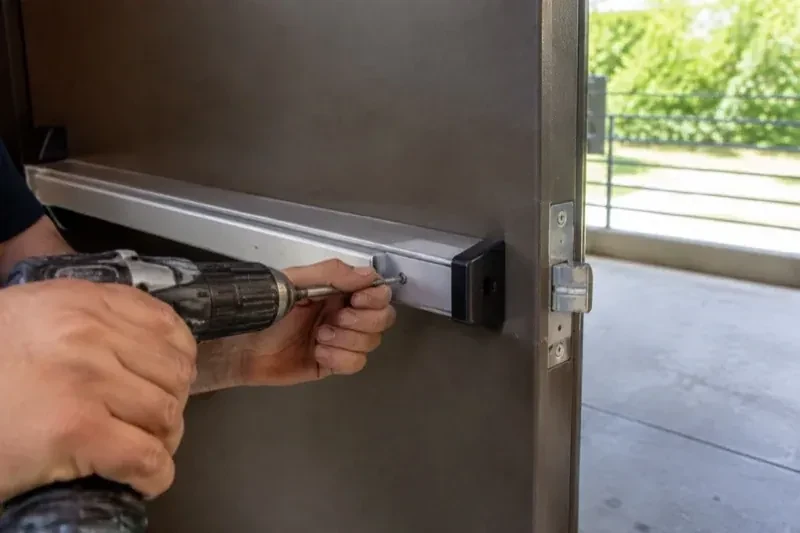
Panic and exit hardware installation fits a commercial door with a device that releases the latch the moment someone pushes on it from the inside, so the room's occupants are never asked to find a key to leave. The locksmith works from the room's occupancy and the door's fire rating first, then chooses a rim, mortise or vertical-rod device to suit the opening, pairs it with outside trim that still controls entry, and tests the release force and the latch before handing the door back. Any electrified addition, such as an alarm or a link to access control, is fitted once that basic function is confirmed.
How the visit goesThe daycare wants the yard gate and the classroom door alarmed so a staff member hears the moment it opens, without turning either into something a child could be shut behind.
Mississauga
How the visit goes
Is this door part of a pair?
Single doors and pairs get assessed differently from the first look. On a pair, the locksmith checks whether a mullion currently splits the opening, whether a coordinator is already fitted, and whether the leaves close independently or in a set order. This decides whether the project is a straightforward device swap on each leaf or something larger, such as removing a mullion and fitting a compatible replacement latching arrangement to turn two narrow doors into one wide exit. Getting this right at the assessment stage avoids ordering hardware for a single door when the opening is really two leaves working together.
Handling a pair of doors
On a pair, a coordinator is fitted only where the hardware needs the leaves to close in a set order, letting the active leaf's device seat into the strike or into an astragal carried on the inactive leaf; many pairs latch independently and skip this step entirely. Where the plan calls for one wide exit instead of two narrow ones, the centre mullion is removed and vertical-rod devices are fitted to each leaf instead, arranged so both close and latch reliably. Either way, both leaves are tested together, not only on their own, before the visit is called finished.
A door that opens under one motion, every time
What the space has afterward is straightforward: anyone inside can leave through that door with a single push on the crossbar or touchpad, no key, no second step, no need to remember which way a lock turns. Staff can be shown the motion once and it stays intuitive, because that is exactly what the hardware is built to do. Outside, entry still works the way it was set up to, through the trim chosen for that door, entirely separate from the exit function inside.
Panic & Exit Hardware
In the van
- Door closer
- Request-to-exit switch
- Strike and reinforcement
- Through-fixings and mounting hardware
- Coordinator for door pairs
What affects the quote
Same fees day, night or weekend
1Number of keys or dogging cylinders
Cutting keys for the outside trim and providing a dogging key or keyed dogging cylinder for the device is counted individually, the same way any keyed hardware is.
2Door and frame condition
A door that has sagged, a frame that has shifted, or a strike pocket that no longer lines up needs correcting before hardware is fitted, which adds its own line to the quote.
3Signage and labelling
Any exit signage or alarm labelling the opening needs is a small addition on its own, but it is named in the quote rather than assumed to already exist on the door.
Panic & Exit Hardware: questions
What happens with a pair of doors instead of one?
It depends on the pair. Some latch independently and need nothing extra. Where the hardware calls for a set closing order, a coordinator lets the two leaves close in the right sequence, letting the active leaf's device seat properly into a strike carried on the inactive leaf, or into an astragal. Alternatively, the centre mullion can be removed and a vertical-rod device fitted to each leaf, turning the pair into one wide exit. Whichever applies, both leaves are tested working together, not one at a time.
How is occupant load actually counted for this decision?
Occupant load is calculated from the floor area and the intended use of the room, using published factors for that occupancy type, rather than a headcount taken on a busy night. A building official or a locksmith familiar with the calculation can work through it for a specific room, and the result is what decides whether the exit doors serving that room need a releasing device.
How is panic hardware different from fire exit hardware?
Panic hardware and fire exit hardware share the same push-to-release action, but fire exit hardware is additionally tested and listed for use on a fire-rated door assembly. That extra listing matters because a fire door has to keep an active latch bolt at all times; it cannot carry a mechanical dogging function the way ordinary panic hardware sometimes can, so the two are not interchangeable on a rated opening.
Commercial Locks
- Master Key System DesignA property manager taking over a small commercial building inherits a shoebox of keys with no…
- Access Control InstallationDeliveries arrive before anyone is scheduled to be there, which right now means either propping the…
- Commercial-Grade Lock ReplacementHead office wants every branch keyed alike under one system, and half the locations are still…
Panic & Exit Hardware near you
Choose a service to see how it works in Mississauga. Each page explains the situation it suits, what the locksmith looks at first, how the job is done, and how to look after the hardware afterwards. If your problem sits between two services, either page will get you to the right conversation.